Ever wanted to be the person who can liven up a room with a bit of magic? It's easier than you think. Let's dive into a few simple card tricks that will leave your friends speechless.
There’s a certain kind of quiet that falls over a room right before a magic trick is revealed. It’s a mix of anticipation, curiosity, and a childlike willingness to be amazed. For the longest time, I was just an observer in those moments, convinced that the world of magic was reserved for people with impossibly nimble fingers and years of secret practice. I figured I could barely shuffle a deck without sending cards flying, let alone perform something that could be called a "trick."
Honestly, the thought of trying felt intimidating. But I recently stumbled upon a corner of the magic world that completely changed my perspective: self-working card tricks. These aren't about lightning-fast sleight of hand; they're about cleverness, psychology, and a good story. They rely on mathematical principles and subtle setups that do most of the heavy lifting for you. It’s a game of intellect rather than just dexterity.
This discovery was a game-changer. It meant that the most important part of the performance wasn't the mechanics, but the performance itself—connecting with people, building suspense, and guiding them through a moment of wonder. It’s an incredibly rewarding feeling. So, if you've ever had that little spark of curiosity, that quiet desire to create a moment of impossibility for someone else, you're in the right place. Grab a deck of cards, and let's learn how to do just that.
Your First Trick: The "Key Card" Prediction
This is the perfect trick to start with because its effect is so much bigger than its method. Your friend will be convinced you have psychic powers, but all you need is one little secret: the "key card." The beauty of this trick is that the spectator shuffles the cards and makes all the choices, which makes the final reveal feel utterly impossible. It’s a classic for a reason, and mastering it will give you a huge boost of confidence.
Here’s the step-by-step breakdown. I recommend reading this through a few times and then walking through it with a deck in your hands.
- The Secret Glimpse: Before you even begin, you need to know one card in the deck. The easiest way to do this is to casually glance at the bottom card. Let's say it's the Four of Clubs. This is now your "key card." Commit it to memory.
- The Shuffle and Selection: Hand the deck to your spectator and let them shuffle it as much as they want. This is crucial because it makes them feel in control. Once they're satisfied, ask them to pick any card from the deck, look at it, and remember it. Make sure you emphasize that they shouldn't let you see it.
- The Control: This is the most important part. Ask them to cut the deck in half wherever they'd like and place their chosen card on top of the bottom half. While they're doing this, you're holding the top half. Now, you simply place your half on top of their card. You've just secretly placed your key card (which was on the bottom of your half) right on top of their chosen card.
- Theatrics and Misdirection: At this point, their card is lost in the deck, but you know exactly where it is—right after your key card. To sell the effect, you can do a few simple, non-shuffling cuts. Spreading the cards face up on the table is a great way to build suspense. Say something like, "Now, your card could be anywhere in here, but sometimes it just calls out..."
- The Reveal: Scan the face-up cards for your key card, the Four of Clubs. The card immediately to its right (or the next one in the sequence) will be their card. Don't just point to it. Hover your hand over it, pause for dramatic effect, and then slowly turn it over or slide it out of the spread. The look of astonishment on their face is what this is all about.
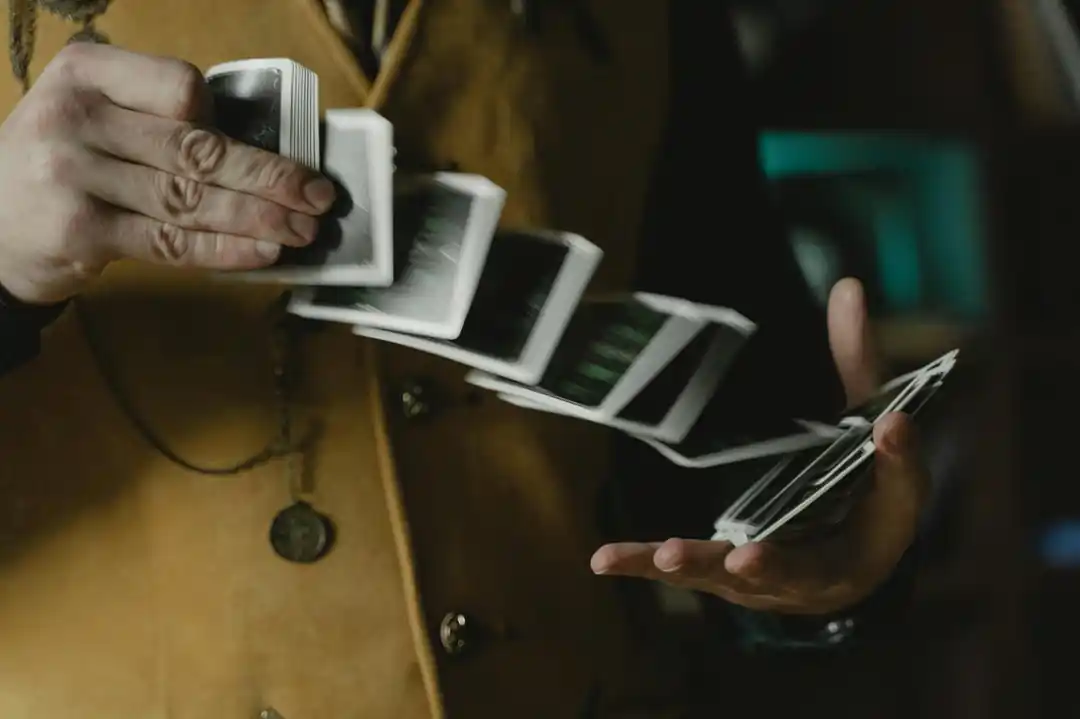
The Automatic Hand: The 21-Card Trick
This is one of the oldest and most reliable beginner tricks in the book. It’s purely mathematical, which means it literally cannot fail as long as you follow the steps. It’s a bit longer than the key card trick, but its methodical nature is part of what makes it so baffling to an audience. They see you dealing and arranging the cards over and over, and they can't pinpoint where the magic actually happens.
The premise is simple: a spectator chooses a card, it's lost in a packet of 21 cards, and you find it through a process of dealing and questioning.
- The Setup: Count out 21 cards from the deck and set the rest aside. Hand the 21-card packet to your spectator, ask them to choose one card, memorize it, and then shuffle it back into the packet themselves.
- The First Deal: Take the packet back and deal the cards face up into three columns of seven cards each. Deal them one by one, from left to right (card 1 to column 1, card 2 to column 2, card 3 to column 3, card 4 back to column 1, and so on).
- The First Question: Ask your spectator to point to the column that contains their card. Don't ask them what the card is, just which column it's in. Once they point to it, carefully pick up the three columns, making sure to sandwich the chosen column between the other two. This is the core secret of the trick.
- The Second and Third Deals: Repeat the process two more times. Deal the cards out into three columns again, ask them which column contains their card, and once again, pick up the columns, making sure their chosen column is always in the middle.
- The Final Reveal: After the third time, hold the packet of 21 cards face down in your hand. Announce that you've been concentrating on their card and that you can feel its energy. Slowly deal the cards face down one by one, counting as you go. Their chosen card will always be the 11th card. You can reveal it however you like—stop on the 11th card and turn it over, or pre-arrange to have a "magic word" they say as you deal the 11th card.
It's All in the Performance
Learning the steps to a trick is like learning the notes to a song; it's only the beginning. The real magic, the thing that turns a simple procedure into a memorable experience, is the performance. You don't need to be a professional actor, but you do need to be engaging. Your patter—the script you follow while performing—is what gives the trick a soul. It distracts the audience from the mechanics and draws them into the story.
Don't just deal the cards silently. Talk to your audience. Ask them questions. Tell a little story about how you learned the trick or what makes it special. If you're performing the key card trick, you could say, "I'm going to try to create a connection between my mind and one card in this deck." This frames the trick and makes the reveal more powerful.
Most importantly, practice. Practice not just the moves, but what you're going to say. Practice in front of a mirror until your handling of the cards looks smooth and your patter sounds natural. When you're confident, you put your audience at ease and allow them to enjoy the show. Your goal isn't to "fool" them in a malicious way, but to give them a gift—a brief, wonderful moment where they get to suspend their disbelief and just be amazed. And that's a feeling that never gets old.

From Wobble to Glide: Your First Steps to Mastering the Ice
A Beginner's Guide to Writing Comedy That Actually Lands
Related Posts
 HOBBIES
The Beginner's Guide to Reading the Night Sky: How to Spot Your First Constellations
A friendly, grounded guide to navigating the night sky, understanding stellar movements, and spotting iconic constellations without expensive gear.
 PETS
PETSSniffle-Free Snuggles: America's Most-Loved Hypoallergenic Dogs
Dreaming of a furry friend but dreading the sneezes? You're not alone. Let's dive into the wonderful world of popular hypoallergenic dog breeds in the US.

Popular Posts

Rethinking Non-Profit Promotion: Creative Strategies That Actually Drive Event Impact

Beyond Stark White: The Best Interior Paint Colors to Light Up Your New Space

How to Actually Master a New Language on Your Own (No Magic Gene Required)
